Our Sister Site

Please visit our sister site: Crossings Motorhome Tours Ltd

Sunday, 22 February 2015

The Alps - France/Italy border

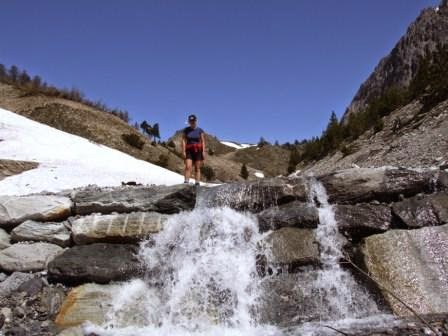
Wendy at 3000 metres.
The first year we started motorhoming we took the van down to the bottom of France, with a view to nipping across the border into Italy. This was in May. We figured that we would just pop across the Alps and take in a bit of scenery on the way. The satnav said we would be there comfortably within a few hours.

Three days later we arrived in Italy after an unexpected mini-break at 3000 metres! To our surprise, even though the temperature was well into the 20s, and even though we were in shorts and t-shirts, most of the passes were still closed due to snow. We've come on a bit since those days and have learnt to be much more respectful of the mountains. 

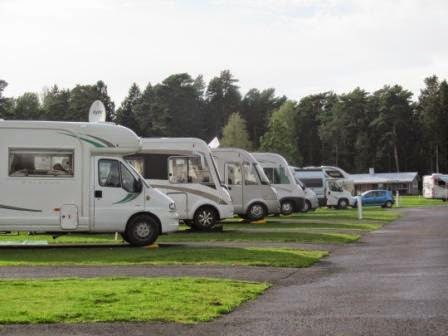
Alpine campsite on the Italian side.
Driving in the Alps is as amazing as you might suspect, with narrow winding roads, very steep inclines and declines and dramatic drops over the side. Our old van was getting very hot as we reached the top of various peaks, and the brakes were burning very hot at the bottom. It's certainly not for the faint-hearted.

The one advantage of our unexpected delay there was that there weren't many people around and we got the aires pretty much to ourselves. We also had a priceless moment when we went for a walk at over 3000 metres (still in shorts and t-shirts) and scared the living daylights out of three local skiers who clearly didn't expect to see anyone on the footpaths.

We steered on the side of caution and limited our walk to the way-marked paths where the snow had cleared. We stopped at the point where the thick layers of icy snow have fairly large streams running beneath them!

Our route took us through via Briancon, Vars, Montegenevra (on the border where we spent a couple of nights in the aire) and ultimately into the beautiful Italian city of Cuneo.

More information: www.montgenevre.comwww.vars.com and 


Sunday, 8 February 2015

Peschiera Del Garda and Lake Garda

Peschiera Del Garda at night.
One of our favourite haunts in Italy is Peschiera Del Garda. As the name suggests it is slap bang on the shores of Lake Garda. In fact it is right at the bottom of the Lake and is the site of a sixteenth century island fortress. It's a very relaxed place for shopping, eating and general pottering around. At night all the cafes and restaurants light up to magical effect.


More information on the town: www.lakegarda.com/peschiera.php

We like it for its close proximity to some of Italy's finest cities including Verona and even Venice. It is also a fantastic place just to spend your time on a sunny day around the lake.


Lake Garda.
Lake Garda is the largest of the lakes in Italy being over 50km long at up to 17 kilometres wide. Although it's a really popular tourist hotspot, assuming you don't go in the height of August, there is plenty of room to enjoy the lake and to find a pitch on numerous campsites that actually border the lake.

More information on Lake Garda can be found at:
http://www.visitgarda.com/en/lake-garda-data/?s=313

We can recommend either of these campsites close to the town and train station and on the shores of the lake: www.campingdelgarda.it/ and http://www.campingbutterfly.it/EN/Default.aspx


Wednesday, 28 January 2015

The E6 in Norway

The Arctic Circle Visitor Centre.
It's not often that I write a blog entry about a road, but my thoughts have turned again to the Arctic Circle, which we hope to visit again soon.

One of the most amazing things about Norway is that once you get up past Trondheim, it really is pretty much the only road left! The E6 in fact starts down at the ferry port in Trelleborg, Sweden and goes nearly 2000 miles right up to Kirkenes in the north of Norway. 


Following the E6 is a bit like the European equivalent of following Route 66. Well maybe not but you get the idea. It's pretty epic. En route you take in some major cities including Malmo and Gothenburg in Sweden and then Norway's capital Oslo.


A typical fjord - the rainbow was a bonus!
The real excitement for us started after Trondheim when the traffic thins out and there are just a few locals, truckers and fellow motorhomers left. Road repairs are done while the road is open as there is no other way of doing it. That means that for certain stretches you are driving on dirt road! 

The scenery is absolutely phenomenal with ever-present fjords and hills. We said 'wow' on every turn. The small towns you come across tend to be pretty and have everything you need to continue your journey although it is advisable to get diesel whenever you see it.

Overnight stops are plentiful and free as there are many lay-bys and 'aires' by the side of the road, including a great one at the Arctic Circle itself. It's a mammoth trip - but it stays in the memory for years.

Thursday, 1 January 2015

Central Paris by motorhome!

Priority motorhome parking outside the Louvre!
We have never driven into the centre of Paris although plenty of people do with motorhomes and even caravans. We have never felt the need as there are quite a few decent sites on the outskirts that are very easy to get to and you can then just use the train to get in. Options include sites at Versailles (with the added advantage of visiting the palace), Melun ( a nice little town in its own right) or the slightly more urban Paris Est site at Champigny. 

The Champs Elysees

Versailles is probably the nicest as it's set in a wooded area and only 5 mins from the RER, which then takes you straight along the Seine. You can be at the Eiffel Tower in 20 mins! Melun is the easiest to get to and is on the Seine, not too far from Fountaineblue. It does take a little longer to get in to Paris though than the other sites. Paris Est is probably the most difficult to get to simply due to the weight of traffic, but is one of the nearest sites to the centre as it's only a few minutes on the train.

The last time we went on our way back from a Germany trip in November, we stood and watched the traffic around the Arce de Triomphe for a while and pondered driving in some time just for the hell of it. A little later we walked back to the Louvre and were amazed to find a motorhomer parked right out the front! It did have a disability badge on it otherwise I think he would have been moved on pretty quick.


Sunday, 14 December 2014

European campsites

One of the most common questions we get asked is about the quality of European campsites. There isn't an easy answer to this question as standards and quality do vary from country to country and from place to place.
Wooded site near Arnhem with private bathroom block!


We have experienced the full range in our time with some that we would go back to again and again, some that were OK and very few that we thought were completely awful. 

There are some general rules of thumb that you can apply when choosing a site:

1. Use one of the big "schemes". There are plenty available -  the main ones being ACSI or Alan Rogers. Both guarantee a certain standard. We have used both very successfully. 
2. There are several smaller schemes some of which are country-specific, such as Vekabo 'minicampings' in Holland, which are worth considering.
3. Use a 'chain'. This could be the very large holiday businesses that operate multiple sites, or independents that have grouped together. In either case they are very protective of their 'brand' and usually work hard to maintain standards.
ACSI inspected site on a lake near Dieppe

4. Go on recommendation. Use Trip Advisor or any of the the other independent review sites. If someone has taken the trouble to do a review that normally means it was particularly good or bad.
5. Be realistic in tourist hot spots. Campsites in tourist hot spots don't normally have to try too hard to fill their spaces and some get very complacent. Consider using a site a bit further away from the hotspot and travelling in by public transport.
6. City centre sites can be crowded and very urban (obviously). This might be fine, or you might choose to stay further out. We have stayed on urban sites in Stockholm, Paris, Tallinn, Budapest etc which are pretty basic with stretched facilities and lots of (sometimes noisy) young people. However these sites are slap bang in the cities so you can live with it.
7. Be aware of what 'type' of site you are staying on. For example, in France the Camping en Plain Aire or Camping a la Ferme are likely to be rural, probably fairly basic, small, privateley owned and usually fantastic little places in amazing locations.
Genuine 5-star site in Linkoping. Dedicated fully serviced
hard-standing motorhome pitches. Excellent facilities and restaurant.

8. Be wary of five star sites. Stars are often awarded arbitrarily and at best relate to the range of facilities rather than the quality. Some of the worst sites we have stayed on have been classified as five star!

Monday, 24 November 2014

A Taste of Provence

St Pauls near Cannes
Our Taste of Provence Tour has proved to be our most popular tour so far this year. In fact it is now fully booked! Thoughts have naturally turned to our last trip down to Provence, which was early Spring this year.

Provence is an incredibly varied area and perhaps this goes some way to explaining its popularity. To the west there are three towns that should not be missed: Arles, Avignon and Aix-en-Provence. They all capture the spirit of the region. Avignon is perhaps the pick of the three with its medieval walls and unfinished bridge across the Rhone.

If its medieval towns you're after you will be in the right place. The much photographed Gordes is simply stunning located on a hillside overlooking the plains in the wide valley beneath. Nearby is the highly unusual Bories Village where all the buildings are made using dry-stone walling techniques - including the roofs.
Avignon

Heading down onto the coast is famous French Riviera, which could not be much more of a contrast. Slightly chintzy perhaps but typically warm even out of season and with access to the Med. Cannes and Nice are the two main towns that lie in close proximity on this stretch.

Heading north you come into the lavender growing region. This area is also famous for producing perfumes centred around the fairly small town of Grasse.

Overall, the favourable climate, amazing varied scenery, historical cities and towns and coast, not to mention the cuisine and wine, make Provence unmissable.


Sunday, 9 November 2014

The Rhine and Moselle

We have been lucky enough to find a spare fortnight to get down to the Rhine and Moselle valleys. Our main intention was to try out a few new sights for the tour next year.
Mainz sunset


Late autumn is actually a brilliant time to go as it turns out, mainly as you get such a rich variety of colours. The valleys of the Rhine and in particular the Moselle are relatively sheltered and hold on to what heat there is around. That's why they are such good areas for grapes!

There aren't that many people around in early November and the only people to to tend to see are fellow motorhomers. The Rhine and Moselle are littered with 'aires' all the way down. I would imagine that they are difficult to get onto in the season, but at this time of year you would have no trouble.

Most of the sites close at the end of October so we managed to get on a few. It's quite an odd experience being on a site on the last day before it closes.

Half timbered houses near the Rhine
Highlights of the area are the stretch from Cologne to Mainz on the Rhine and then from Koblenz to Trier on the Moselle. Koblenz is the meeting point of the Rhine and Moselle called "German corner". There are dozens of castles and small towns down the rivers, any of which are worth stopping at. Cologne, Bonn and Mainz are probably the pick of the larger places, with Bernkastel Kues and Cochen the best of the smaller towns.

We were lucky with the weather in that it was mainly dry, sunny and mild, but we can't wait to get back there in late Spring 2015.