Our Sister Site

Please visit our sister site: Crossings Motorhome Tours Ltd

Tuesday, 20 May 2014

Luxembourg

Perhaps an unusual choice of destination, but Luxembourg packs quite a punch for a country of only half a million. So what do you think of when someone mentions Luxembourg?
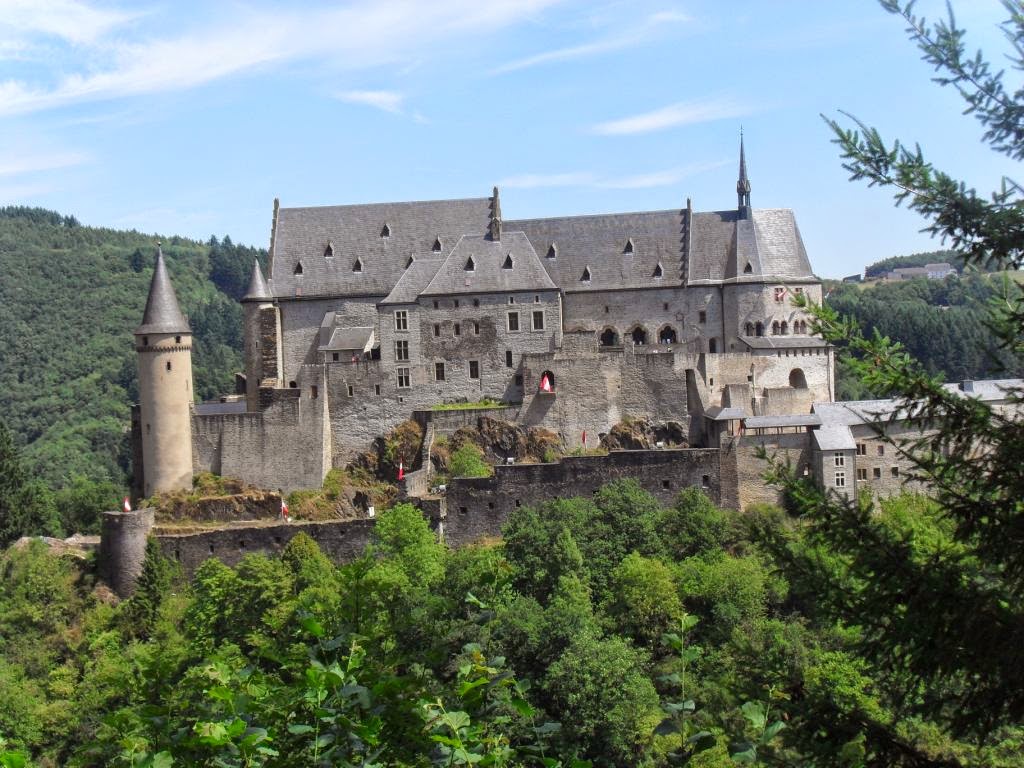
Fairytale castle at Vianden

We had no preconceptions when we visited a couple of years ago, and to be honest we went there en route to Germany rather than as a specific trip. However, there were plenty of things there that surprised us and kept us entertained.


Luxembourg City, the capital is a relatively compact place but still has the feel of a European capital. It's easy to navigate by public transport, bike or even on foot. It's history dates back hundreds of years including a spell under Roman influence. Highlights include the castle and the old quarter and the fortifications. The city is surprisingly hilly and leafy giving plenty of opportunities to climb out and look down. There is also an incredibly well-kept American  war cemetery.
Wendy in Luxembourg City

Away from the capital, Luxembourg has a reputation for fairytale castles and forests. We visited Echternach and Vianden to scratch that particular itch, and also the Chateau de Bourscheid. Walking and cycling opportunities are in abundance here although we did find the cycling a bit challenging at times, both due to the hills and to the slightly impatient drivers!

The Moselle passes through Luxembourg and constitutes part of the wine-making territories perhaps more associated with Germany. There is a wine route in the Remich region giving you the opportunity to sample and buy.
Luxembourg City

In terms of food and drink in general, one of Luxembourg's attractions are the low taxes they put on things like alcohol, cigarettes and fuel. All of this leads to a bit of 'duty free' type tourism with some people making a specific trip through the country to stock up. It remains one of the cheapest places in Western Europe for diesel!


Sunday, 4 May 2014

Provence dans le camping car

Typical Provencal Town
 Wendy's favourite film is 'One Good Year', which we own on video and have to watch every time it is on Film 4 - and that's quite a lot. It's a romantic tale of a successful city banker who inherits a vineyard in Provence from his Uncle. He is then faced with the tricky choice of either carrying on his career in the city or making wine and living in a chateau with a beautiful French woman. I think you can work out how it's going to end!

Rich in Greek and Roman history, the area now is best known for wine, lavender, unspoilt historic towns and villages, mountains, gorges, rivers and coast. It really is an area of contrasts. It's also an area of tourists so you need to pick your times and locations.

Anyway, the best part of the film is that it's set in Provence and this year we managed to do a bit of location-spotting as we travelled the length and breadth of the area. Provence covers a large area in the south east of France from the Rhone in the west across to the Italian border. It also encompasses a vast stretch of coastline onto the med, the Cote d'Azur.

The coast is inevitably busy when the sun comes out. We have been down in this area as early as April, and you can feel the season starting already. By June, the beaches are fairly packed although it's still possible to get on local campsites. The main larger cities and towns that we visited on the coast are Nice and Cannes (both chintzy and glamorous resorts) and Toulon (rich in naval history).
The Bridge at Avignon

For us though, the main attractions are inland. There are some beautiful towns the pick of which are Avignon and Aix-en-Provence. There are also some fantastic hillside towns such as St Paul's and Gordes. The latter of these was where they filmed much of 'One Good Year' so inevitably we made a trip. Nearby is an amazing medieval village called Les Bories, where all the houses are made entirely out of dry stone walls and roofs.


Provence really  makes the most of its natural resources and there are loads of opportunities to visit vineyards, lavender fields and even perfumeries (in Grasse) on top of all the gastronomic treats in the region.

Our advice is to go in Springtime so you get decent weather while missing the worst of the crowds.

Monday, 21 April 2014

Best way to visit Paris by motorhome

Arc de Triomphe
Paris is our favourite city. We sometimes make a specific trip just to go there but more often than not we try to encompass a visit on the way to or from other destinations. It's a particularly nice way to end a holiday knowing that you are going to give yourself a day in the French capital.

Our first suggestion for a site would be Camping La Belle Etoile in Melun. The town is OK but the main attraction is that the train station is around 20 mins walk or 5 mins by bike to the train station. From here you can get into Paris for around 30 euros return in about half an hour.

The site itself is on the Seine and is quite large and well laid out. It does tend to attract a few migrant workers and younger people among a fairly mixed crowd of campers, caravanners and motorhomers. It's on the Camping Cheque Scheme, which makes it a cheap option low season. It's also the right side of the city for a trip to Fontainebleau, which is easy to get to and park even in your motorhome.
Me at the near the Eiffel Tower with designer bag


We tried a new site this year, Camping Versailles run by Huttopia. This is just outside Versailles in a wood. It's 10 mins by bike to the palaces and only 5 mins walk to the train station. From here you can catch the RER, which means you can get off anywhere you like along the Seine. It's literally 20 mins by train to the Eiffel Tower.

This is not a busy line if you avoid rush hour, so we had a very relaxed trip in and out of the city, which only cost about £6 for a return. The campsite is expensive though. We went in April and the standard rate is around 30 euros a night. However, it is on the ACSI scheme, so you can get it for 18 euros. We stayed for 2 nights to allow a day around in Versailles itself and just one day in Paris. 
Inside Fountainebleau


It's a bit more tricky to get in and out of than Melun, particularly if you are trying to avoid toll roads. The approach is a bit narrow too. However, this has now become our favoured campsite for Paris and we will be heading back there as soon as we can.

Sunday, 6 April 2014

Northern Italy motorhome - including Venice!

We have just come back from a whistle-stop trip down through France to Italy and back. Why? Well mainly to get to Venice. Venice is one of those places that we never thought we would visit, maybe because it's so touristy and expensive. 

Wendy in St Marks' Square, Venice

However, having had a look at the map, although it's on the other side of Italy, it is northern and Italy is so narrow that it's much nearer than we first thought. Add to that, the excellent cheap and reliable Italian train system meant that we were able to drive less and use the trains more than we would in other European countries.

The route we took was down through France using the aires. We over-nighted at the medieval walled city of Provins on night 1 and then onto Suerre on another free aire on the banks of the Saone. Day 3 of driving got us down near the Italian border ready for a crossing via the Mont Blanc tunnel.

A one-way ticket costs around 50 euros (75 for a return). You can queue for ages here but at this time of year we sailed through. Entry to the tunnel is strictly controlled for safety purposes to minimise the amount of traffic in the 11km tunnel at any one time. You also have to keep a 150m gapo between you and the car in front.

You are well into (and under) the Alps by now and having been stuck in them even in May due to the passes still be closed, we were happy to pay the toll charges to stay on the motorway that cuts a lower straighter path. Italian tolls are actually very reasonable.
Gondolas on the Grand Canal


After a night in an Alpine campsite where we were the only ones on, we headed for Lake Garda. There are loads of options for visits around here including Milan, Turin and Verona. We opted for the smaller but much raved about Verona, which we found to be compact enough to have a comfortable day seeing the sights.

The site we stayed on was called Butterfly and was on the very bottom of the lake. We highly recommend it not least for the excellent staff. The site is around 300 metres to the local train station from where we were able to travel the 125km into Venice for just ten euros each (and the same to get back).

Venice has to be seen to be believed. It is like stepping into a movie set. It is just like you see on the TV or in a film. Hundreds of narrow canals, gondalas vying for position with water taxis, delivery boats and tourist boats. It's busy, noisy, crowded and expensive. However, it's also possible to find yourself a quiet corner and cheap(ish) cafe if you look hard enough.

The Rialto Bridge
The highlights are St Mark's Square and the Rialto Bridge, but to be honest, the main attraction is just wandering the narrow paths around the canals and watching the world go by. We were completely exhausted after wandering around for about 7 hours. In all that time we didn't actually go in anywhere as we wanted to see as much of the city as we could and the weather was about 20 degrees (not bad for the end of March).

You could happily spend 4 or 5 days here if you had the budget and wanted to take advantage of the various museums and other attractions. We were happy with the one day though as we felt we really got a taste of the city as a whole.

Friday, 14 March 2014

Last day of the holiday

It's an age-old problem - what to do with the last day of your holiday. There are two approaches really. 
1. Stay as long as possible in your location and then bomb back to the ferry port in a mild state of panic.
2. Get back to the port really early and have half a day to kill.
Hardelot Plage


We've tried both and have come down on the side of number 2. There are two main reasons for this. The first is that we tend to use the P&O Dover-Calais crossing as it is such good value and very reliable. Depending on how busy they are, if you turn up early at the port, they will often let you on to an earlier crossing without having to pay extra. So if you are really not in the mood for killing time, try your luck!

The second reason, is that there are so many interesting places to visit that are within an hour or two of Calais, that you can happily spend half a day. We have ended up getting to know the coastline of northern France really well simply because we have the time to explore it on the last day of the holiday.
Le Touquet


Starting at the bay of the Somme and working your way north, there are dozens of coastal towns and fishing villages that are worth a visit. Obviously these get busy in the summer months and you will find that parking is restricted in the towns themselves. Out of season, it's fantastic! 

The following is a list of places that we have happily spent a few hours:


Cayeux sur Mer: Lovely little holiday town with long pebble beach and hundreds of beach huts.
Le Crotoy: Smack bang on the Somme Bay so ideal for walking on the sands, bird and seal watching.
Fort Mahon Plage: Large sandy beach and dunes.
Berck: Feels like an English Victorian seaside resort with massive nineteenth century houses and long sandy beach.
Le Touquet: the favoured coastal resort for rich Parisians in its heyday. Lots of expensive shops. Very popular and you will have to park out of town even in low season.
Calais Town Hall

Boulogne: Perhaps a little bit more pleasant than Calais now that the ferries have stopped running. UNESCO listed belfry and also a castle. Also has Nausicaa the national sea centre. 
Europe City: If you like duty-free shopping and want to do lots of it, then this is your best bet. It's basically a big out-of-town shopping centre. There is dedicated motorhome parking.
Calais: Often overlooked, there are actually some nice bits of Calais!The sea front is the main attraction but there are also some interesting museums. At the right time of year, the flowers at the town hall gardens are amazing.


Monday, 24 February 2014

France and Flanders - The Great War commemorations

The memorial at Amiens
Having just finished watching the excellent BBC1 series on the Great War with Jeremy Paxman, our thoughts turned to the touring we did late last year in Northern France and the Flanders region.

We have always found it quite difficult on our travels when we visit areas that have been the scene of serious fighting. On the one hand, there we are on our holidays enjoying ourselves, while at the same time we are treading the same ground as millions of people who lost their lives in battle. 

This is obviously the the case all over Northern France for both world wars and we have experienced similar unease travelling in the Balkans where the evidence of the fighting in the early 1990s is still evident from the bullet-strewn houses.


Reminders of more ancient history near Azincourt
The memorial at Grand Fort Phillipe
Our conclusion to this, particularly with the world war sites is that all those millions of people that fought and died are the reason that we are now free to wander around Europe. Without their sacrifice the shape of Europe would undoubtedly be completely different. In a sense, we should really celebrate the fact that we have these freedoms. We have also found that when you realise the hardship that our very young people went through in the wars, it really puts any problems you might have yourself into perspective.

It was in this spirit that we toured the areas that saw some of the heaviest fighting in the Great War. There are some fantastic commemorations to the war in this area. There is a lot to take in around this area and rather than try to list them all here, try: http://about-france.com/tourism/great-war-france.htm if you want some ideas of where to visit.

We found the museum at  Peronne to be particularly interesting and thought-provoking. Perhaps the most poignant places to visit though are the numerous war cemeteries, some dedicated to the British and others to specific allied countries. You will even find some German and Russian ones. You can get a map of all of these from any of the tourist information centres. 


Saturday, 15 February 2014

Burstner 625T Harmony

In a slight deviation from the usual topics on the blog (i.e. travel), this week's installment is going to be purely about our new van, which we took delivery of this Friday.
We really like the low profile cab


Since we started motorhoming in 2009, we have had the same van, a left hand drive 1997 Hymer Camp, which we bought from Ikonik Campers near Hull. That van has been an absolute legend for us as we covered somewhere around 45,000 miles in it, rarely having to spend anything on it apart from the usual (tyres, batteries etc). We have only really changed vans now as we wanted something newer and with lower miles for the business.

Wendy actually cried as Jon and family (the new owners) took it off our drive last weekend. However, the tears were short-lived as we were only six days with a motorhome-shaped hole on our drive. We bought the new van privately off eBay from a lovely couple in Wakefield.

The van is a Burstner T625 Harmony. The best advice we were given when we started was to 'go German' and this seemed to have served us well. The build quality is on a par with the Hymer and we particularly like the layout of this one. It has captain's chairs up front, which we did not have before, which give you a lot more room and have the effect of moving the living area a metre forwards. In addition there are another four seats, two behind the table and two perpendicular.
Lots of space even with a fixed bed

Behind that you have the L-shaped kitchen that Burstner seem to have on most of their models. This gives lots of preparation area and means that whoever isn't cooking can move around the van without getting in the chef's way. This model also has a full-sized fridge and a proper oven. We made do with a microwave for four years, but are looking forward to being able to cook properly.

Behind that is a French fixed bed and a toilet with separate shower area. We are not sure about the bed yet as we will have to see how we get on with the cut-away at the end of it. The shower room will be a treat as it means we can both be in the bathroom at the same time.

On the mechanical and technical side, the van is fully loaded. It's a Fiat 2.8 diesel, which has an excellent reputation. We had done 115,000 miles on our old 2.5TDi and that still had tens of thousands of miles left in it. This engine is bigger and smoother and has only just done 50,000 miles.


Right hand drive might take some getting used to
It has had the Gaslow (refillable) system fitted, which we be a real benefit as we tend to stay away for long periods. It also has an up-rated Truman 6e boiler, which will work on electricity as well as gas. That will save us a considerable amount of gas when we are hooked up. There are also two solar panels which need re-instating. All in all, it will allow us to operate very effectively wherever we park the van. There is even a transformer that will give 240v even when we are not hooked up!

On the back we have a motorcycle rack in addition to the bike rack, so we are now in the market for a 125cc scooter, which will give us a bit more flexibility when we are on-site and don't fancy taking the van out or cycling.

Overall we are very happy with the van. Burstner do seem to put a bit more effort into the design, layout and styling of their vans compared to Hymers of a similar age. Obviously time will tell as to whether the Burstner proves to be as lovable a van as our old Hymer. First impressions though are really good and we just can't wait to get it across the channel.