Our Sister Site

Please visit our sister site: Crossings Motorhome Tours Ltd

Sunday, 14 September 2014

Top 10 European Capital Cities in a motorhome

We often get asked which are our favourite cities so here's the top ten, roughly in order. The fact is that we like pretty much all of Europe's capitals so here goes anyway:
Budapest at night


Paris - we never fail to find something new to d however many times we visit Paris. We just feel drawn to the Eiffel Tower and it gives us a warm fuzzy feeling every time. Plus there are a few sites that are very easy to get to on the outskirts and you can just come in on the train.

Lisbon - although we have never been here in the van we flew in a couple of years ago and fell in love with it. It's relaxed, open and hot!

Stockholm - set on several islands on the archipelago. Packed with interesting museums and buildings yet very easy to navigate and lots of green spaces.
Surprising Zagreb


Copenhagen - lively and a bit touristy but fantastic architecture and easy to cycle around.

Ljubljana - the capital of Slovenia. Small and beautiful.


Bern - the capital of Switzerland. Also small and beautiful.

Vilnius - this one was a bit of a surprise for us as we didn't know what to expect from the capital of Lithuania. However, we found it to be much more charming than Riga and less commercial than Tallinn. Quite compact with a lovely castle on the hill overlooking the city.

Zagreb - gritty in places and not as touristy as all the others. Therefore worth visiting!

Vienna - simply overwhelming with a really handy campsite about 6 miles out on the banks of the Danube.
Copenhagen with emergency ponch

Budapest - similar feel to Vienna we thought and similarly spectacular with the added bonus of a city centre campsite about 3km out.


Wednesday, 3 September 2014

Wonderful Copenhagen

It's been a while since the last blog as we have just been away on our Summer In Sweden trip. We have blogged a lot about Sweden as it is one of our favourite trips. One of the additional benefits of visiting Sweden is that you pass very close to the Danish capital, Copenhagen.
View from the tower with the bridge in the background

In terms of logistics, Copenhagen is really easy to get to and there is a fantastic site called Absalon Camping, which is just off the motorway but only about 5 miles from the city. There are bus and tram stops nearby or you can cycle in on dedicated cycle paths. If you do cycle, you will find that there are hundreds of other people doing the same thing as the cycle paths criss-cross the entire city and are really well-observed i.e. you don't get people walking on them like you do in Britain.

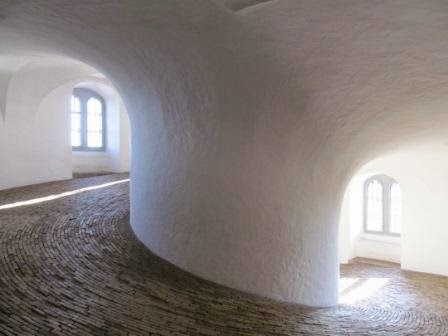
In common with other capitals you really need a few days to get round it all, but even with just a day, you can get a really good flavour of the place. Our particular favourites are the Round Tower and the Cathedral, both of which are very close to each other, but you will find that just wandering the streets is a visual treat.

Last time we visited we searched in vain for the Little Mermaid and made a more determined effort to see it this time. We were glad of the bikes as it is a little way north of the main centre. It's only about 3 foot high and a bit of a disappointment to be honest, but that didn't stop it being the most popular attraction in the city.
Inside the Round Tower

You will hear lots of English spoken and the place does tend to fill with tourists from all over the world. Expect lots of Chinese, Japanese and Americans and if the cruise ships are in, the crowds swell even bigger. Having said that you can still find a quiet cafe or corner of a park to relax.

One final observation is the that Copenhagen is only a few miles from the Oresund Bridge that joins Denmark to Sweden. If you go up any of the towers and look east, you will see it on a clear day.

Monday, 14 July 2014

Wild camping / Aires/ Stellplatz etc

We often have conversation with fellow motorhomers and friends about the thorny issue of wild camping. They range from those motorhomers who make it a badge of honour never to stay on a campsite through to those (usually non-motorhomers) who get very agitated by big white buses spending the night "where they're not supposed to". I guess we fall somewhere in the middle of the two extremes.
3000 metres up in the Alps


Our definition of wild camping is anywhere that isn't a campsite and for us that mainly means the aires or aire equivalents in the various countries we have visited. Germany actually have a much bigger network of what they call "stellplatz", even though it is France who are much more well-known for them.

We are not averse to parking overnight (sensibly) in other places, but we only tend to that in those countries with a 'right to roam'. Scandinavia for example is a great place for wild camping, particularly as you head further north in Norway, Sweden or Finland.

Here's a quick whizz through of the pros and cons of the aires:

Pros:

  • They are often free or cheap
  • You can normally empty your grey and toilet and get water (at extra cost)
  • They are often in perfect spots near rivers, beaches, harbours, town centres etc
  • You are free to come and go as you please at any time and there is no checking in and out
  • They are perfect stop-overs for those longer driving days when all you are going to do is eat, sleep and leave.


Cons:

  • They can be busy, overcrowded and cramped in high season or in popular areas
  • Popular ones have started charging more making them less good value compared to sites
  • You don't get showers and other campsite facilities
  • Security is not as good as a campsite
  • Stockholm - bit crowded and expensive but handy for the city
  • There can be comings and goings at all time of the day and night making them noisy.


We tend to be a bit canny using aires these days. As we often travel in low season, there are many occasions where an aire might cost you 8 euros plus another 3 to use the service point, where you could stay in a fully loaded campsite on one of the schemes for about 15 euros, or a local independent campsite for about 12 euros.

On other occasions when you have been driving all day, paying for a campsite where you won't even get the chance to use the facilities can seem to be bad value for money. We've also had some noisy nights on aires (but then we've had them on campsites too!)
A free night next to a Swedish lake


In summary, you need to pick and choose. We spent a whole holiday using aires once and by the end we really just wanted to get on a site. On the other hand, we've stayed on sites and felt that we have been overpaying for very basic facilities. Unless you keep going back to the same sites and aires over and over again, it's always going to be a bit of pot luck. 


Monday, 23 June 2014

Amiens

We often get asked to recommend good spots for short motorhome trips on the continent. The Netherlands and France are the two most obvious places for a short holiday as they are the nearest countries to us. France is probably our favourite for a short hop, although it is such a big country, that if time is limited then you are unlikely to get out of the North.

Tended plots in the Hortillonnages

Many people just fly through the northern parts of  France en route to the sunnier south. However, there are lots of interesting places to visit that are less than two hours from Calais. One of these is the surprising, compact city of Amiens. 

The city is just under 100 miles from Calais and could be reached by a gentle drive down the coast road before heading inland. There is a campsite and (commercially run) aire on the outskirts of the town but they do insist on a two-night minimum. We have used a site around 6 miles north of the city in the grounds of the Bertangles Chateau. It's a simple, clean and very pretty site with large marked pitches.

Bertangles Chateau
There are a few highlights of the city itself, although the star has to be the amazing Gothic cathedral, the largest of its type in France. Viewed from a distance, up-close or from the inside. it's awe-inspiring. Visits are free and the doors are open until 6.30pm. During the summer and autumn they light it up at night, although you do have to stay up late if you visit in June like we did.

Another highlight, just a few hundred metres from the cathedral is the Hortillonnages, an area of ancient marsh land, which has been cultivated into beautiful gardens and allotments. For about a fiver, you can float serenely around the waterways on a small boat for around 45 minutes. The sun was shining when we went and it was magical.

If you have longer for the city there is plenty more to see and do. Have a look here for a few more ideas: www.visit-amiens.com.


Monday, 2 June 2014

Holland again!

You tend to forget how nice some places are even when you visit them regularly. We have just returned from a fantastic trip to the Netherlands and despite a couple of dodgy days with the weather, we had a fantastic time.
The windmills at Kinderdijk

Travelling with customers has added a whole new dimension and even made us see some places in a new light. It is not our intention to feedback on actual tours in the blog, but rather to offer ideas of places to go and things to see, whether they are part of one of our organised tours or not. It just so happens that we had such a great time that we wanted to blog about it! If you are one of our couples and you are reading then thanks so much for making the trip so enjoyable - if felt like we were travelling with friends.

Anyway, if you have about a week or so to spend we would highly recommend the following:


  • Dordrecht in the south is a beautiful and compact town with a network of canals and river frontage. The town is largely unspoilt by the war (unlike nearby Rotterdam). We were lucky as they had a steam festival on too.
    Surprising Maastricht
  • Kinderdijk near Rotterdam is a series of 19 traditional windmills all within about 1 mile of each other. Fantastic photo opportunity if nothing else!
  • The South Limburg region is under-explored. It is mainly rural and perfect for cycling. You can also visit the slightly un-Dutch city of Maastricht, which has the feel more of a French or Belgian town.
  • We've probably mentioned it before the Hoge Veluwe National Park with its 1700 free white bicycles makes a great day out (even in the rain). The cafe near
    the visitor centre is superb.
  • Amsterdam itself is obviously a must-see.
  • Alkmaar was something brand new for us on this trip and seeing the cheese market in full swing was a real treat. The town itself has plenty to keep you interested for the afternoon after the market is finished.
    Amsterdam
  • Delft and The Hague are very close to each other so you can do Delft in the morning and nip into The Hague on the train in the afternoon for a bit of hustle and bustle.

So that's all a bit of a whistle stop tour, but we found that our days were more than full. In fact we rarely got to bed before 11pm!


Tuesday, 20 May 2014

Luxembourg

Perhaps an unusual choice of destination, but Luxembourg packs quite a punch for a country of only half a million. So what do you think of when someone mentions Luxembourg?
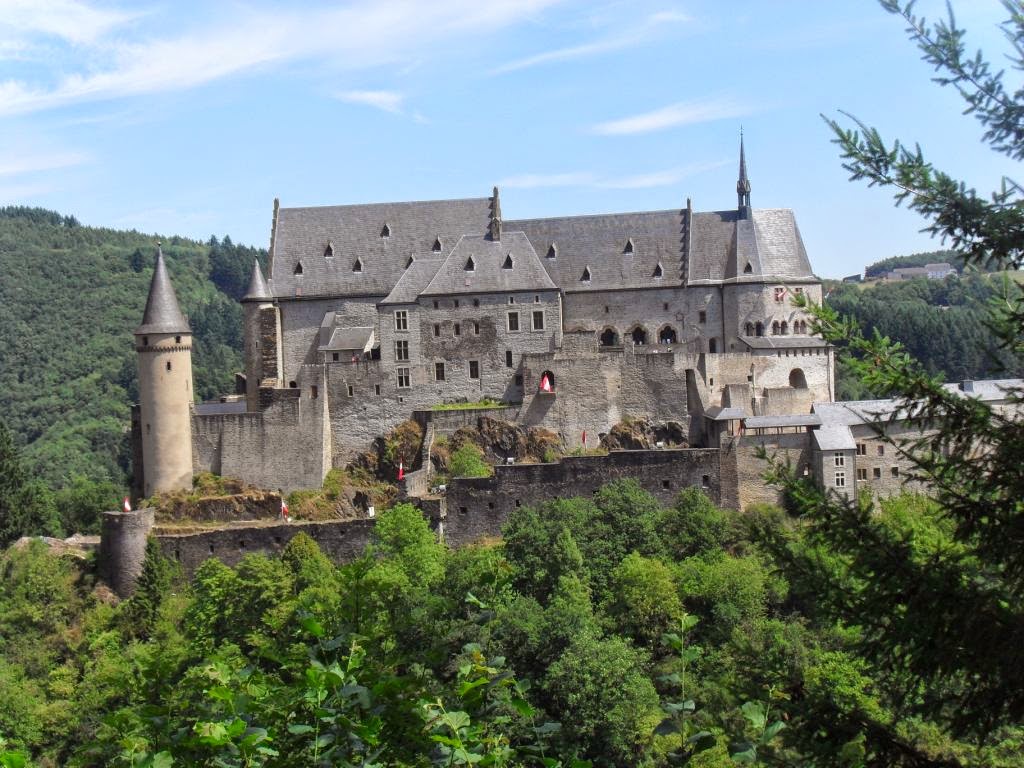
Fairytale castle at Vianden

We had no preconceptions when we visited a couple of years ago, and to be honest we went there en route to Germany rather than as a specific trip. However, there were plenty of things there that surprised us and kept us entertained.


Luxembourg City, the capital is a relatively compact place but still has the feel of a European capital. It's easy to navigate by public transport, bike or even on foot. It's history dates back hundreds of years including a spell under Roman influence. Highlights include the castle and the old quarter and the fortifications. The city is surprisingly hilly and leafy giving plenty of opportunities to climb out and look down. There is also an incredibly well-kept American  war cemetery.
Wendy in Luxembourg City

Away from the capital, Luxembourg has a reputation for fairytale castles and forests. We visited Echternach and Vianden to scratch that particular itch, and also the Chateau de Bourscheid. Walking and cycling opportunities are in abundance here although we did find the cycling a bit challenging at times, both due to the hills and to the slightly impatient drivers!

The Moselle passes through Luxembourg and constitutes part of the wine-making territories perhaps more associated with Germany. There is a wine route in the Remich region giving you the opportunity to sample and buy.
Luxembourg City

In terms of food and drink in general, one of Luxembourg's attractions are the low taxes they put on things like alcohol, cigarettes and fuel. All of this leads to a bit of 'duty free' type tourism with some people making a specific trip through the country to stock up. It remains one of the cheapest places in Western Europe for diesel!


Sunday, 4 May 2014

Provence dans le camping car

Typical Provencal Town
 Wendy's favourite film is 'One Good Year', which we own on video and have to watch every time it is on Film 4 - and that's quite a lot. It's a romantic tale of a successful city banker who inherits a vineyard in Provence from his Uncle. He is then faced with the tricky choice of either carrying on his career in the city or making wine and living in a chateau with a beautiful French woman. I think you can work out how it's going to end!

Rich in Greek and Roman history, the area now is best known for wine, lavender, unspoilt historic towns and villages, mountains, gorges, rivers and coast. It really is an area of contrasts. It's also an area of tourists so you need to pick your times and locations.

Anyway, the best part of the film is that it's set in Provence and this year we managed to do a bit of location-spotting as we travelled the length and breadth of the area. Provence covers a large area in the south east of France from the Rhone in the west across to the Italian border. It also encompasses a vast stretch of coastline onto the med, the Cote d'Azur.

The coast is inevitably busy when the sun comes out. We have been down in this area as early as April, and you can feel the season starting already. By June, the beaches are fairly packed although it's still possible to get on local campsites. The main larger cities and towns that we visited on the coast are Nice and Cannes (both chintzy and glamorous resorts) and Toulon (rich in naval history).
The Bridge at Avignon

For us though, the main attractions are inland. There are some beautiful towns the pick of which are Avignon and Aix-en-Provence. There are also some fantastic hillside towns such as St Paul's and Gordes. The latter of these was where they filmed much of 'One Good Year' so inevitably we made a trip. Nearby is an amazing medieval village called Les Bories, where all the houses are made entirely out of dry stone walls and roofs.


Provence really  makes the most of its natural resources and there are loads of opportunities to visit vineyards, lavender fields and even perfumeries (in Grasse) on top of all the gastronomic treats in the region.

Our advice is to go in Springtime so you get decent weather while missing the worst of the crowds.